
Interview with researchers 20
Research on human-robot
communication
“Harmonious and helpful relationships
between humans and robots will foster
positive changes in future society”
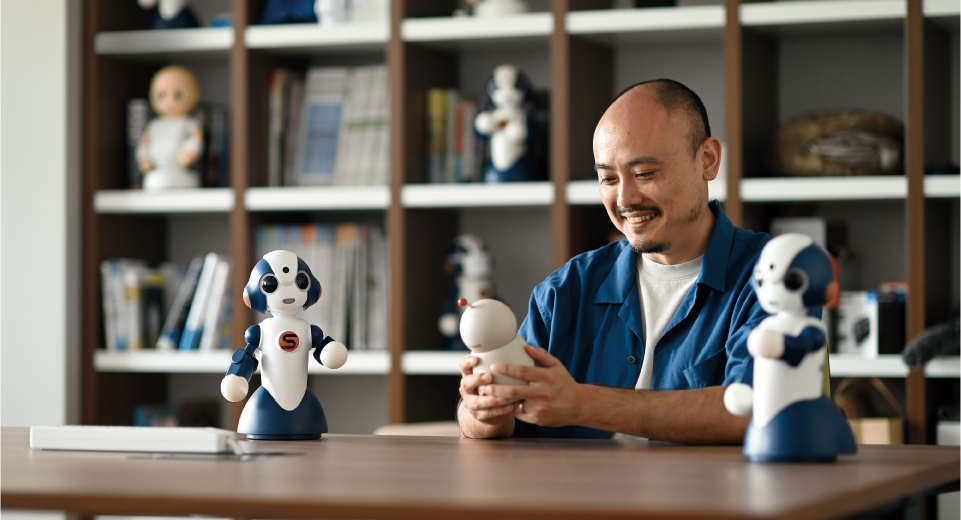
- Interview IIO Takamasa
- Associate Professor,
Faculty of Culture and Information Science
Research on human-robot communications in the real world
Progress on robotics and artificial intelligence (AI) has accelerated in recent years, and at breathtaking speeds. The benefits have been widely publicized, such as reduced labor shortages and greater work efficiencies. Meanwhile, some express doubts as to whether we can fully trust robots and AI, starting with the threats of job loss. Certainly, numerous issues must be confronted and resolved to adapt these technologies to actual society.
Dr. Takamasa Iio’s research is truly in the front lines tackling these needs. “Intelligent robots” are the aim of his research field, where robots make decisions and act with human-like intelligence. Dr. Iio’s key aim is the development of robots that can interactively communicate with people. “There are two types of communication,” he explains, “that which uses language, and that which is not language-based. My research adds this non-verbal language of a robot’s physical characteristics to language-based communication, all with the idea of people and robots sharing the same spaces.”
In his student days, Dr. Iio joined a laboratory engaged in multi-agent simulations, designed to approximate the principles of human behavior. Using AI technology, this research involved the use of computer-graphics (CG) characters called “agents” for simulation within virtual computer space. There were no robots involved. Gradually, however, Dr. Iio came to the idea that “physicality” was indispensable for such research. In fact, “physicality” was a keyword in AI research and development (R&D) at the time. The basis for this idea was that human intelligence was acquired as the body interacted with and reacted to its environment. Dr. Iio’s initial steps in robot research came when he served as an intern at the Advanced Telecommunications Research Institute International (ATR).
At the time, owing to his pursuit of investigating fundamentals, such as “the essence of life” and “the true nature of intelligence,” Dr. Iio’s initiation at ATR involved a series of surprises. “Although the pursuit of ‘essence’ is also important at ATR, the main idea was to simply find the kind of arrangements and mechanisms that enabled robot movement, and then to experiment with the findings. The key was to make advances and discoveries that would be useful in society. So, rather than elucidating the logic and programs that made robots move, our aim was to make a robot all the same that could mimic human reactions, with the stance that we could then go on to make better and better robots.”
Although somewhat confused at first, Dr. Iio soon became absorbed in robotics research. Visitors always came to the ATR, giving Dr. Iio the chance to see, first-hand, a variety of different people interacting with robots. “I was interested in observing mental and behavioral changes in people as they communicated with robots. I wanted to implement within my robots these findings as I thought that robots and systems like these could surely benefit society.”
Social robots can support difficult jobs and help in “filling gaps”
“The good thing about robots is that they can be useful in the daily life of society,” Dr. Iio emphasizes. They can carry heavy objects and perform work in dangerous areas, meaning that “we can leave the hard work for robots.” Adding communication abilities can further enhance and expand their work scope and quality.
“Neuroscientific studies have shown that human behavioral abilities improve when they are praised by others. Although I am not a neuroscientist, my work can be said to involve those specific areas of the brain involved in motor functions, especially those that are activated by outside praise. While the efficiency of learners has been shown to improve by intentional praise, it is difficult to secure people who are able to skillfully praise others, not only once but continuously as necessary. My research aims to give robots the ability to objectively evaluate and provide praise.”
One study involved training test subjects to perform keyboard inputs, followed the next day by a repeat training session. Subjects were divided into two groups, one that was praised by an agent (a robot or a CG character), and one that received no such praise. The result was clearly better performance by the praised group compared with that of the not-praised group. Then, without changing the amount of praise, further improvement was seen in the praised group when two agents were assigned to give praise (Fig. 1). “We found higher effects in the development and maintenance of motor abilities when not one, but two agents were assigned to give simple praise, such as ‘Well done!’ or ‘Amazing! You’re doing great!’ Perhaps this means that having a few more people who can give praise is best. ‘Well, what if we increase the number of agents?’ This is the kind of idea that comes up in robot-related research.”
Meanwhile, a key aim of research in social robotics is determining ways of developing robots that are readily accepted in general society. This is a fundamental question of robot design. If robot-human interactions can achieve the same results verified in person-to-person studies, then robots can be equipped with these functions. Further, if robots are enabled to provide support for so-called “work that falls between the gaps” (that is, work that cannot readily or willingly be performed by humans), this would bring beneficial changes to society. Dr. Iio emphasizes, “I think robots have the potential to perform roles also in elderly care facilities and in psychological counseling. Professional staff have only limited opportunities to communicate among themselves, but robots can provide a way for such intercommunications. Issues and emotions that are not easily communicated to another person, sensitive topics and so on, can be readily communicated to a carefully listening, socially sensitive robot.”
Establishment of robot guidelines for long-term relationships analogous to those between humans
Dr. Iio now intends to also engage in research on robots that can contribute to the vitalization of human relationships within organizations.
For example, some companies have low participation rates in in-company events, and one fear is that not enough information is being shared with the employees. Dr. Iio is experimenting with the use of robots as a means of resolving these kinds of issues. “Suppose we place two robots within the coffee-break space of the company cafeteria. They could engage in conversation with company employees: ‘Do you know about today’s event?’ ‘Are you aware of the details?’ Then we could measure the impact of these communications on the actions of the newly informed or reminded employees. In fact, we plan to verify these effects in an upcoming study. In these and in other ways, robots could have positive impacts on stimulating activity and relationships within the organization.”
One theme of Dr. Iio’s upcoming research is “methods of establishing long-term relationships between people and robots.”
“Regular, continued use of a convenience store or cafe, etc., never fails to bolster relationships between the customer and workers, as epitomized in the statement, ‘Thank you for your continued patronage!’ I think it would be interesting to see such normal, friendly relationships established between humans and robots. A robot’s memory could keep large amounts of time-related data, such as what conversations were engaged in and when, and the specific date and time when the human trusted the robot enough to share more open-hearted communications. This kind of data has never been generated in psychological experiments and can be expected to assist in the development of communications theories, and in many other ways.”
Through such research, Dr. Iio plans to summarize his findings in the form of guidelines for establishing human-robot relationships that will also incorporate principles garnered from social psychological theory and other relevant sciences. These human-robot relationships that start with conversations will surely develop and flourish into a bright future where robots and people can live together in harmony.
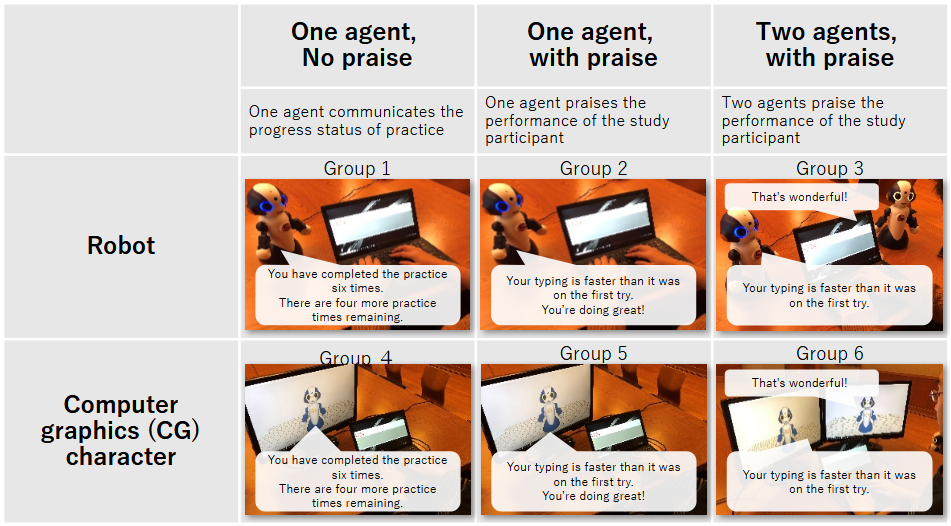
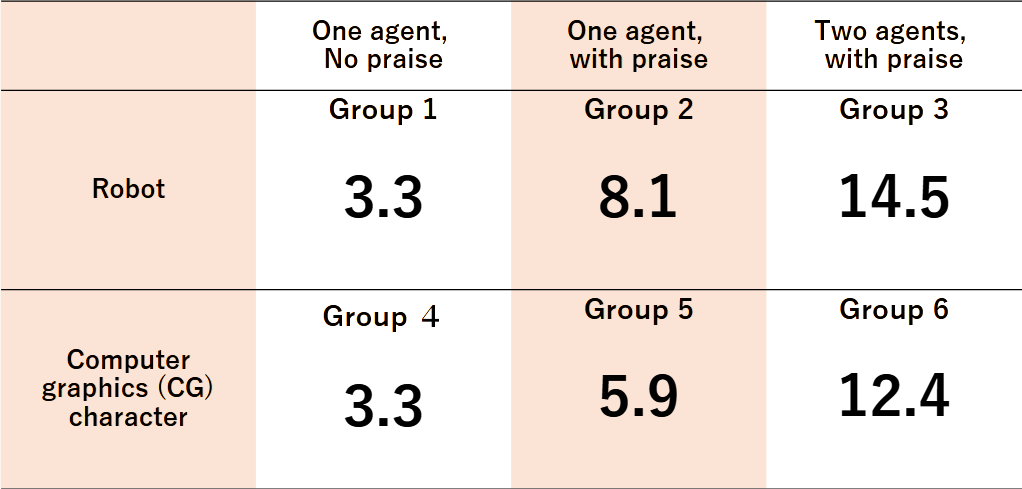
Average rate of performance improvements (%) under various conditions
PROFILE
- Research Areas
- Social Robotics
- Research Goal
- The development of robot systems to support the cultivation of social capital
- Research Themes
- • Exploring possible uses of communication robots for the welfare and education fields:
Considerations based on research and development of robots that communicate with
elderly persons (Special issue on changes to language education by artificial intelligence
(AI) and information and communication technology (ICT))
• Examples of field trials of information-provided robots and related challenges
- Researcher Database
- https://kendb.doshisha.ac.jp/profile/en.2d43820dd3ad0376.html
Faculty of Culture and Information Science